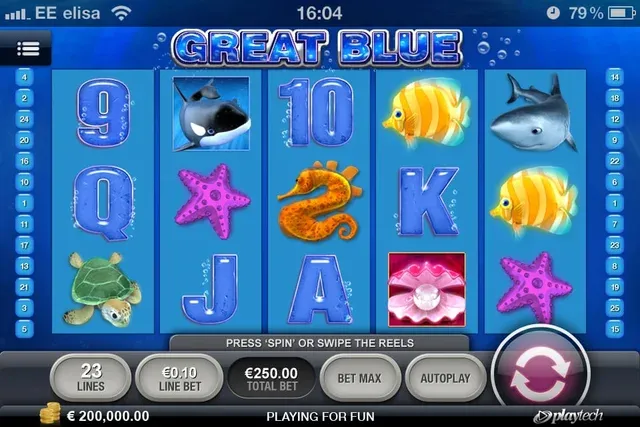


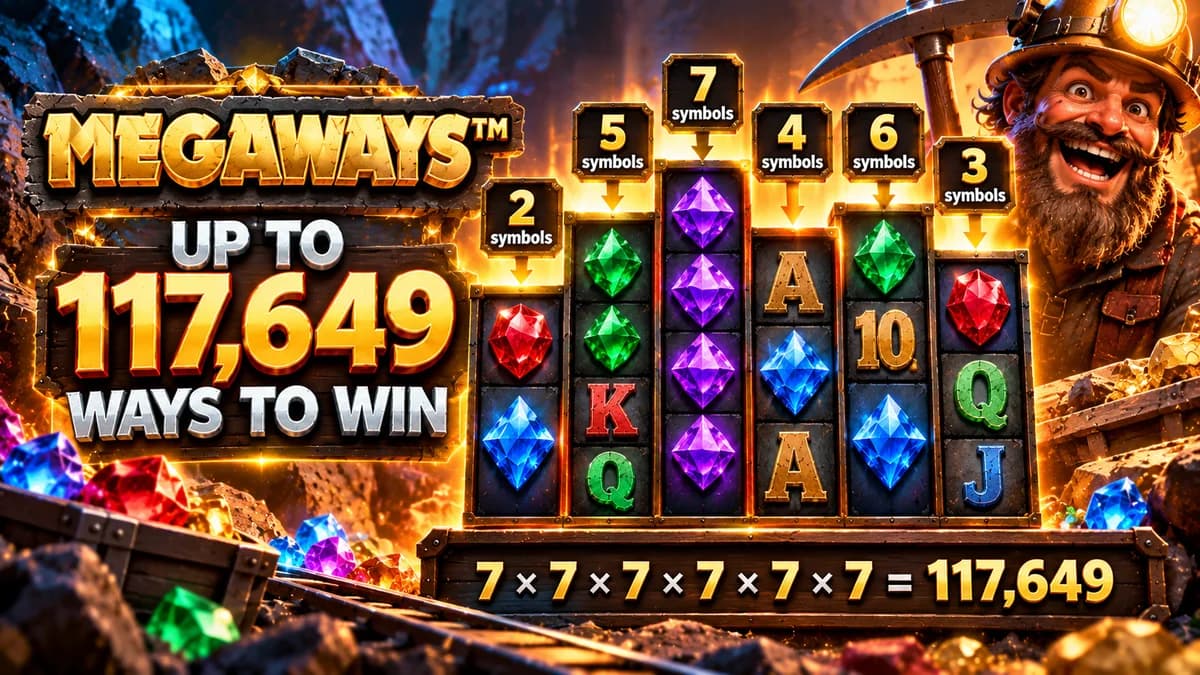

Megaways slots use changing reel heights to create a different number of possible winning combinations from one spin to the next. The famous “up to 117,649 ways to win” figure comes from a classic six-reel configuration where every reel displays seven symbol positions, but that maximum is only one possible reel state. A normal spin can contain thousands of ways rather than 117,649, while selected Megaways slots can expand beyond the classic limit during bonus features.
The mechanic was created by Big Time Gaming and became one of the most widely licensed slot systems in modern iGaming. Bonanza turned Megaways into a recognisable category, Extra Chilli built feature purchase and a Free Spins gamble around it, White Rabbit pushed the reel structure to 248,832 Megaways, and newer releases such as Extra Chilli More Chilli and Monster Quest show that variable reels can now sit underneath far more elaborate bonus systems.
The most important thing to understand is that Megaways changes how winning combinations are constructed – not the fundamental mathematics of RTP or house edge. A game with 117,649 ways can have a lower RTP than a conventional payline slot, and a spin showing more Megaways does not automatically have “better odds” in the sense many players assume.
What is a Megaways slot?
A Megaways slot uses a variable-reel engine instead of keeping exactly the same number of visible symbols on every reel. In a classic six-reel format, each reel can commonly display between two and seven symbols, meaning the total number of possible winning combinations changes according to the current reel heights.
If one spin shows relatively short reels, the game may calculate only a few hundred or several thousand ways to win. If all six reels reach their maximum seven-symbol height, the same game can display 117,649 ways.
That makes Megaways fundamentally different from a fixed 243 Ways or 4,096 Ways slot. In those games, the number of active positions normally stays constant, while Megaways slots recalculate the number of ways after the reel structure for that spin has been generated.
The exact implementation can vary between games. Some Megaways slots add a horizontal top reel, some expand beyond seven symbols during bonuses and others combine the mechanic with Hold & Spin, cluster-style features, sticky Wilds or persistent multipliers.
Where does 117,649 Megaways come from?
The famous 117,649 Megaways number is simply the result of multiplying seven available positions across six reels:
7 × 7 × 7 × 7 × 7 × 7 = 117,649
If every reel displays seven symbols, each position on reel one can theoretically combine with each valid position on reel two, then reel three and so on according to the game’s ways-to-win rules.
The important word is maximum. Not every spin in a 117,649-way Megaways slot actually contains 117,649 active ways.
Suppose the six reels show:
2 × 5 × 7 × 4 × 6 × 3
The total is:
5,040 ways to win
Nothing is wrong with the game and no Megaways have been “removed.” The reel heights generated for that particular spin simply create fewer positional combinations.
Why the Megaways counter changes every spin
The changing counter is the visible result of the variable-reel engine. Before the game evaluates the paying symbols, each reel receives its active height for that round.
A reel might show two symbols on one spin and six on the next. Because all six reel heights can change independently, the multiplication used to calculate the current number of ways also changes continuously.
This variability is the core of how Megaways slots work. The game does not start with 117,649 fixed paths and then disable some of them; it creates the reel structure first and calculates the number of possible ways from that structure.
That distinction matters because it also explains why Megaways should not be described as “117,649 paylines.” The game is not drawing more than one hundred thousand predefined paths across the reels.
How wins form in Megaways slots
Most Megaways slots use a ways-to-win model rather than traditional paylines. A matching symbol normally needs to appear on consecutive reels beginning from the required side, while its exact vertical position is usually irrelevant.
Imagine one symbol appears twice on reel one, three times on reel two and twice on reel three. Those positions can create:
2 × 3 × 2 = 12 combinations
for that symbol across the first three reels.
If the same symbol appears four times on the fourth reel, the total becomes:
2 × 3 × 2 × 4 = 48 combinations
The mathematics therefore depend on how many matching symbol positions exist on each qualifying reel, not whether the symbols follow one drawn line.
Megaways ways are not paylines
A payline is a fixed visual path. A 20-payline slot generally evaluates the same 20 patterns after every ordinary spin.
A Megaways way is different. It represents one possible combination of qualifying symbol positions across consecutive reels, and because the reel heights change, the total number of those combinations changes too.
That is why saying “117,649 paylines” is technically incorrect. Megaways slots can have 117,649 ways without containing 117,649 fixed lines.
This difference is especially important when comparing Megaways with traditional slots. A five-reel payline game may require three identical symbols to sit on one specific path, while a Megaways game can combine matching symbols at different vertical positions as long as the required consecutive-reel rule is satisfied.
Does 117,649 ways mean 117,649 chances to win?
Not in the way that phrase is often interpreted. The 117,649 figure describes the maximum number of positional combinations created by the reel layout; it does not mean the game is making 117,649 independent bets with equal probability.
Symbol distribution still matters. High-paying symbols can appear less frequently than lower-paying symbols, Wilds can be restricted to selected reels and feature symbols can follow their own probability rules.
The paytable also matters because one game can pay relatively little for a large number of ways while another allocates more value to rarer combinations. A large ways count tells you about reel structure, not the complete probability of winning money.
That is why the number at the top of a Megaways game should be read as a structural statistic rather than as a direct “odds” figure.
Do more Megaways mean better odds?
More Megaways on one spin can create more potential positional combinations than fewer Megaways on another spin, but that does not mean Megaways slots have better long-term odds than other slots. The complete mathematical model already accounts for how often different reel heights appear and how symbols are distributed across those reels.
A developer can balance a large number of possible ways through symbol frequency and payout values. A slot offering 117,649 maximum ways can therefore have the same RTP as a ten-payline game, while another Megaways title can have a higher or lower theoretical return.
The correct distinction is:
More Megaways = more possible symbol combinations in that reel state.
It does not automatically mean:
More Megaways = higher RTP, lower house edge or a higher probability of finishing the session ahead.
RTP and Megaways are separate
RTP measures the theoretical percentage of wagered value returned by the complete game across an extremely large number of game rounds. Megaways describes how the reel structure generates winning combinations.
Big Time Gaming’s Bonanza, for example, is currently listed around the 96% RTP level while using up to 117,649 ways. Other Megaways slots can publish different percentages even if they use the same maximum number of ways.
That is possible because 117,649 says nothing about how probability is distributed among symbols, bonuses and payout values. Two Megaways games can use identical reel dimensions while having different RTP, volatility, hit frequency and maximum payouts.
This is one of the most important principles in understanding Megaways slots properly.
Can two 117,649-way Megaways games have different RTP?
Yes. The reel engine only defines the structural possibilities of the game.
One title can be configured at 96.5%, another at 96%, and another can have several approved RTP versions available to operators. The visible reel mechanic can remain essentially the same.
Extra Chilli More Chilli, for example, publishes an RTP range rather than one universal percentage. It still runs on the classic six-reel Megaways engine with up to 117,649 ways.
The active RTP should therefore be checked inside the individual game rather than inferred from the Megaways label.
Are Megaways slots always high volatility?
No. Megaways does not prescribe a volatility level. The mechanic changes reel height and ways to win, while volatility describes how unevenly payout value is distributed.
Many famous Megaways slots are medium-high or high volatility because Big Time Gaming and licensed studios often combine the mechanic with cascading wins, growing multipliers and bonus rounds containing large upper-tail potential. That design history has created a strong association between Megaways and volatile play.
However, the association is not a mathematical requirement. A provider can build a different volatility profile around the same variable-reel engine.
The volatility rating therefore needs to be checked game by game.
Why Megaways slots often use cascades
Cascading wins work naturally with variable reels because one paid spin can move through several different symbol states. After a winning combination is paid, the symbols contributing to that win disappear and new symbols enter the empty spaces.
The game then evaluates the new arrangement. If another win forms, another cascade or reaction can occur without requiring a new paid spin.
This structure can produce several consecutive wins from the same initial round. Megaways determines how many combinations are available on the reels, while cascades determine what happens after one of those combinations wins.
The two mechanics complement one another, but they are not the same thing.
Megaways and cascades are separate mechanics
A slot can use cascades without being Megaways. Sugar Rush, for example, uses cluster-based wins and tumbling symbols without relying on the Megaways reel engine.
Likewise, the defining characteristic of a Megaways game is variable reel height rather than the presence of cascades. A developer could theoretically build a Megaways game whose winning screen resolves without a chain-reaction system.
This matters because reviews often describe Megaways as if variable reels, cascades and progressive multipliers were one inseparable mechanic. They are separate layers that developers frequently combine because they work well together.
Understanding those layers makes it easier to compare different Megaways slots instead of assuming they all behave like Bonanza.
Bonanza shows the classic Megaways formula
Bonanza remains one of the most useful games for understanding how Megaways slots work because its structure is relatively clean. Big Time Gaming lists the game with up to 117,649 ways and around 96% RTP, while the reel system is combined with the provider’s Dual Reaction mechanic.
Winning symbols disappear, replacement symbols enter and another winning evaluation can occur during the same paid round. The horizontal reel above the main reels also changes as reactions continue.
This creates the basic rhythm associated with many early Megaways games: variable reel heights → win → reaction → new symbols → another possible win.
Bonanza’s importance therefore extends beyond one famous slot. It became the reference point for the mechanic itself.
Bonanza Free Spins show why multipliers matter
Four GOLD Scatters trigger Free Spins. Additional Scatters can award more spins before the feature begins.
During Free Spins, every successful reaction increases the win multiplier. The multiplier can continue growing as long as winning reactions continue, giving longer sequences progressively greater potential.
This feature became one of the defining ideas associated with high-volatility Megaways slots. The variable reels create the combinations, but the progressive multiplier determines why later reactions can become much more valuable than early ones.
That distinction is useful when comparing Bonanza with newer Megaways releases where the multiplier may be only one part of a much larger bonus system.
Extra Chilli made feature access part of Megaways
Extra Chilli retained the Megaways-and-reaction foundation while changing how the bonus was approached. Its Feature Drop system allowed direct access to the feature where supported, while the Free Spins Gamble let players risk the number of spins initially awarded.
That made feature entry itself part of the game. Instead of simply landing Scatters and accepting the resulting bonus, the player could choose whether to gamble for a larger Free Spins package.
The game also uses an unlimited multiplier during Free Spins. Extra Chilli therefore shows that Megaways is only the reel engine; the identity of a Megaways slot usually comes from the features layered on top of it.
This became even clearer when BTG returned to the series in 2026.
Extra Chilli More Chilli shows modern Megaways design
Extra Chilli More Chilli launched in September 2026 with up to 117,649 ways, but the reel number is almost the least interesting part of the sequel. The game adds Chilli Bonus Respins and four separate persistent modifiers: Duplicate Wild, Increased Ways, Double Multiplier and Chilli Wild.
Three HOT Scatters trigger ten Free Spins with one Chilli Bonus active. Additional Scatters can add more modifiers, and the feature can eventually begin with all four bonuses active simultaneously.
The game also retains an unlimited win multiplier during Free Spins. The result is a Megaways slot where several persistent game states can operate at the same time rather than one multiplier simply increasing after every reaction.
This is a good example of how far the mechanic has evolved since Bonanza without changing its underlying variable-reel principle.
Increased Ways changes the minimum reel structure
One of Extra Chilli More Chilli’s four modifiers is particularly relevant to understanding Megaways. Increased Ways guarantees at least four symbols on each reel.
That does not mean every spin suddenly has the maximum 117,649 ways. It raises the minimum reel-height conditions, changing the lower bound of the possible Megaways configurations.
This demonstrates that a game can modify the Megaways engine itself during a feature rather than only adding Wilds or multipliers around it.
Power Play provides another route into the Chilli Bonus system, while Bonus Buy can provide direct feature access where supported.
Why some Megaways slots exceed 117,649 ways
117,649 is the classic Megaways maximum, not a universal limit. A developer can increase the number of positions, add reel extensions or create larger bonus states that push the ways count beyond the standard six-reel 7×7×7×7×7×7 calculation.
Big Time Gaming’s White Rabbit is one of the clearest early examples. During Free Spins, Cake symbols can extend reel heights by adding additional symbol positions.
The reels can grow until the game reaches 248,832 Megaways, more than double the familiar 117,649 figure.
The mathematics have not fundamentally changed. The game simply has more active symbol positions to multiply together.
White Rabbit and 248,832 Megaways
White Rabbit uses an Extending Reels system during its feature. Cake symbols add two extra positions to selected reels, increasing the number of available symbol combinations.
BTG officially promotes the game with up to 248,832 Megaways. The feature demonstrates why “117,649-way Megaways” should not be treated as the definition of the mechanic itself.
The underlying principle remains variable reel geometry. Change the maximum number of active positions and the ways count changes too.
White Rabbit also introduced Feature Drop, allowing direct access to Free Spins under supported conditions. This makes it another important milestone in the evolution of Megaways beyond Bonanza.
Can Megaways go into the millions?
Yes, depending on the game structure. Once developers add more reels, additional active positions or special expanding bonus states, the number of possible combinations can increase rapidly.
The multiplication principle remains the same. If each reel has more available positions, the total rises exponentially because every additional position can combine with positions across the other qualifying reels.
That does not mean a game with millions of ways has millions of times better odds than one with 117,649 ways. The developer still controls symbol frequency, payout values and the complete mathematical model.
A bigger ways figure is therefore best understood as a structural feature rather than a measure of generosity.
Megaways vs 243 Ways
A fixed 243 Ways slot typically uses five reels with three active positions on each:
3 × 3 × 3 × 3 × 3 = 243
The important difference is that those positions normally remain constant. Every base-game spin uses the same 243-way structure.
Megaways takes the same broad ways-to-win logic and makes the reel heights variable. 243 Ways is fixed; Megaways is dynamic.
That makes 243 Ways a useful bridge between paylines and Megaways. Both remove the need for fixed visual lines, but only Megaways changes the number of available ways from spin to spin.
Megaways vs 4,096 Ways
A common six-reel 4,096-way structure can be created by showing four symbols on each reel:
4 × 4 × 4 × 4 × 4 × 4 = 4,096
Again, the main distinction is whether the reel dimensions remain fixed. Fruit Merge Megapots, for example, uses 4,096 ways rather than Megaways.
That game can still contain Hold & Spin, progressive multipliers and jackpot mechanics without needing a variable reel engine. Megaways does not determine how feature-heavy a game is; it only determines how the active reel structure creates ways.
This is why comparing slot mechanics by ways count alone can be misleading.
Megaways vs fixed paylines
A fixed-payline slot uses predefined routes through the reels. A 20-line game usually evaluates the same 20 paths on each ordinary spin, although features can sometimes alter the structure.
Megaways calculates winning combinations from symbol positions across adjacent reels instead. The vertical position of a matching symbol usually does not need to follow one specific drawn path.
Feature | Megaways | Fixed-Payline Slot |
|---|---|---|
Reel height | Variable | Usually fixed |
Winning paths | Dynamic ways | Predetermined lines |
Ways count | Changes between spins | Usually fixed line count |
Symbol vertical position | Usually flexible | Must follow active payline |
Cascades | Common | Game-specific |
RTP | Game-specific | Game-specific |
Volatility | Game-specific | Game-specific |
Neither structure is automatically more favourable mathematically. They are simply different methods of recognising winning combinations.
Megaways vs Cluster Pays
Cluster Pays removes traditional lines in a different way. Rather than requiring matching symbols across consecutive reels, cluster games usually need groups of identical symbols to touch horizontally or vertically on a grid.
Megaways normally remains reel-oriented. The game checks matching positions across adjacent reels even though those reels may have different heights.
This means a large cluster slot can look visually similar to a large Megaways game while using completely different win mathematics. Megaways cares about consecutive reels; Cluster Pays cares about connected symbol groups.
The two formats can both use cascades, which is one reason they are sometimes confused.
Megaways vs Pay Anywhere
Pay Anywhere is another distinct system. In a Pay Anywhere game, the required number of matching symbols can often appear anywhere on the grid without touching and without occupying consecutive reels.
Megaways usually still requires a valid consecutive-reel relationship. A symbol appearing several times on reels one, three and six may not create a Megaways win if reel two lacks that symbol.
Therefore:
Megaways = matching symbols across qualifying consecutive reels.
Cluster Pays = connected groups.
Pay Anywhere = enough matching symbols anywhere on the grid.
These are three different ways of removing traditional paylines.
Megaways vs xWays
xWays is a Nolimit City mechanic that can also increase the number of available ways, but it works very differently. An xWays feature symbol reveals several copies of the same paying symbol and can expand the relevant reel position when it activates.
Megaways changes reel heights as part of the normal reel engine. xWays is event-driven; Megaways is structural.
Both mechanics can therefore make reels larger and increase possible combinations, but the trigger conditions and mathematical implementation are different.
This makes Megaways vs xWays a useful standalone comparison rather than two names for the same mechanic.
Who invented Megaways?
Big Time Gaming created the Megaways mechanic. BTG’s own company history identifies Bonanza’s 2016 launch as a pivotal moment in the studio’s growth, while its current materials describe Bonanza as the game that introduced Megaways to a much wider market.
The mechanic was later licensed to other developers. That licensing strategy allowed Megaways to appear in games produced by studios with no direct corporate relationship to Big Time Gaming.
The result is that Megaways now describes a licensed slot mechanic rather than one individual BTG series.
A game can therefore be a Megaways slot without being a Big Time Gaming slot.
Which studios make Megaways slots?
Big Time Gaming remains the provider most closely associated with the mechanic, but Megaways has been licensed widely. Other studios have used the engine while adding their own visual style, bonus features and mathematical profiles.
This explains why two Megaways slots can feel dramatically different even when both advertise 117,649 ways. One studio may focus on Sticky Wilds, another on Hold & Spin and another on persistent multipliers or jackpots.
The licensed mechanic creates the reel framework, while the individual provider creates the rest of the game.
That is why there is no universal Megaways RTP, volatility level or maximum payout.
Licensed Megaways does not mean identical mathematics
Licensing the reel engine does not require every studio to copy Bonanza. The developer still chooses symbol distributions, pay values, Wild behaviour, bonus frequency, volatility and feature structure.
A licensed Megaways title can therefore have a completely different RTP or hit frequency from a BTG game. The max win can also vary by tens of thousands of times the stake even if both games use the same maximum reel configuration.
This distinction is crucial for comparison content. The word Megaways tells you how the reels can behave, not what the entire game is worth mathematically.
Users should compare the exact title rather than treating the mechanic itself as a quality rating.
Megaways and hit frequency
Hit frequency measures how often a qualifying win occurs. The Megaways count does not directly reveal that percentage.
A spin with many ways may contain more positional combinations, but symbol weighting and payout rules determine how frequently those combinations actually produce qualifying wins.
Two 117,649-way games can therefore have different hit frequencies. More visible combinations do not force the developer to make winning rounds more common.
Hit frequency should be checked separately wherever the provider publishes it.
Megaways and max win
The same separation applies to max win. Bonanza can use 117,649 Megaways and have a much smaller max-win ceiling than another game using the same number of ways.
Monster Quest, for example, also uses up to 117,649 ways but is listed with a 99,900x max payout. White Rabbit 2 can reach an even larger ceiling while using expanded reels and additional feature systems.
That demonstrates why max win is determined by the complete game rather than the Megaways count.
The reel structure provides the possible winning combinations; multipliers, bonuses, symbol values and payout caps determine how valuable those combinations can become.
Monster Quest shows how far Megaways has evolved
Monster Quest is a 2026 Big Time Gaming release combining up to 117,649 ways with Hold & Spin and a battle-driven progression system. BTG lists the game with a 96.58% RTP and a 99,900x maximum payout.
The variable reels still matter in the base game, but most of the game’s identity comes from the Knight, Dragon and Monster symbols inside the feature. Hold & Spin creates a separate mathematical environment where characters can interact across Respins.
This is an important evolution. Modern Megaways slots increasingly use the mechanic as the foundation underneath a much larger bonus system rather than making changing reel heights the main feature users remember.
That is why Megaways remains relevant without every new release feeling like another Bonanza.
Megaways and Hold & Spin can coexist
Hold & Spin usually changes the game from ordinary reel evaluation into a Respins-based state where selected symbols remain locked while empty positions are respun.
There is no conflict between that mechanic and Megaways. A slot can use variable reels in the base game and transition into a Hold & Spin environment after the relevant trigger.
Monster Quest and several newer BTG titles illustrate this stacking of systems. Megaways controls the normal reel engine, while Hold & Spin controls a separate bonus state.
This is another reason modern mechanic terminology should be treated as layers rather than mutually exclusive categories.
Megaways and jackpots
Megaways can also coexist with jackpot systems. MONOPOLY MEGAPOTS, for example, combines the Megaways engine with Hold & Spin and BTG’s Megapots jackpot structure.
This creates three different mathematical layers:
- Megaways determines dynamic reel combinations.
- Hold & Spin creates a Respins feature.
- Megapots supplies jackpot tiers and collection mechanics.
The presence of Megaways does not mean the game’s primary identity has to come from the reel count. In a jackpot-heavy title, the most important user intent may be how the jackpot feature works rather than how 117,649 ways are calculated.
That is another sign of how mature the mechanic has become.
What is the difference between Megaways and Megapots?
Megaways changes the number of possible ways to win through variable reel heights. Megapots is a jackpot-oriented system using prize tiers such as Mini, Midi and Mega.
A game can use Megapots without Megaways. Fruit Merge Megapots, for example, uses a fixed 4,096-way structure while making fruit merging and jackpot Coins central to its Hold & Spin feature.
A game can also combine both systems. The shared “Mega” naming is BTG branding, not evidence that the mechanics perform the same job.
The same warning applies to Megaclusters and Megapays, which are also separate Big Time Gaming systems.
What is the difference between Megaways and Megaclusters?
Megaclusters changes grid resolution after winning symbols appear. Winning symbols can split into smaller positions, increasing the number of active symbol spaces available for subsequent cluster combinations.
Megaways changes reel height instead. The dynamic ways are calculated from the number of visible positions across reels rather than by splitting one symbol into several smaller grid spaces after a win.
Both mechanics create more structural possibilities, but one changes reels and the other changes symbol granularity.
Star Clusters and Star Clusters 2 are useful examples of Megaclusters rather than Megaways.
Why unlimited multipliers appear so often in Megaways slots
Cascading wins naturally create a place for progressive multipliers because one paid game round can contain several consecutive winning evaluations. Increasing a multiplier after every successful reaction gives later wins more value without requiring another stake.
Bonanza made this structure famous, and Extra Chilli continued it. Extra Chilli More Chilli still uses an unlimited multiplier during Free Spins while adding several persistent Chilli Bonuses on top.
This combination works well mathematically because the game needs both a long chain of reactions and meaningful symbol wins for the multiplier to become valuable.
The multiplier itself therefore does not guarantee a huge payout. A x20 global multiplier is only useful if the current reaction also produces enough symbol value.
What does “unlimited multiplier” actually mean?
An unlimited multiplier normally means the game rules do not set one small fixed maximum such as x10 or x50 for the progressive feature value. It can continue increasing as long as the conditions that raise it continue occurring.
That does not mean the final payout is literally unlimited. The slot can still have an overall maximum win or exposure limit.
This distinction is important. Unlimited multiplier describes the progression mechanic, not an infinite possible cash payout.
A game can therefore advertise an unlimited Free Spins multiplier and still have a defined 20,000x, 50,000x or another max-win ceiling.
Bonus Buy in Megaways slots
Bonus Buy has become common in modern Megaways slots, particularly in BTG’s newer catalogue. The feature lets the player pay a fixed multiple of the stake to enter a selected bonus directly where local rules allow it.
The purchase does not change the basic definition of Megaways. The bonus can still use variable reel heights, reactions or other features according to the game’s rules.
Different Bonus Buy options can also lead to different game states. One purchase might enter Free Spins while another enters Hold & Spin or a Feature Wheel.
The price therefore needs to be evaluated together with the feature being purchased rather than treated as one generic Megaways bonus cost.
Bonus Buy does not guarantee a large win
A Bonus Buy guarantees the selected feature, not the outcome of that feature. If a 100x purchase enters Free Spins, the resulting feature can still return less than 100x.
The same applies to Megaways games with very large max wins. Direct feature access can remove the need to trigger the bonus naturally, but it does not guarantee the multipliers, reactions or symbol combinations required for the maximum payout.
Buying the feature shortens the route into the bonus; it does not remove the random mathematics inside that bonus.
That distinction is especially important in high-volatility Megaways slots.
What is Power Play in Megaways games?
Power Play is another enhanced mode used in selected Big Time Gaming releases. Instead of entering a bonus directly, it usually modifies the base game in exchange for a higher stake.
Extra Chilli More Chilli uses Power Play to increase the chance of Chilli Bonus Respins. Bonanza More Gold is scheduled to use Power Play to guarantee at least 10,000 Megaways on enhanced spins.
This makes Power Play conceptually different from Bonus Buy. Bonus Buy skips to a feature; Power Play changes the conditions of ordinary play.
The two systems can appear in the same Megaways slot because they solve different problems.
Does Power Play mean more Megaways?
It can in selected games, but not universally. Bonanza More Gold explicitly uses a Power Play configuration designed to guarantee a minimum Megaways level.
Another game may use Power Play to increase feature frequency or activate another mechanic rather than changing reel heights directly.
Therefore, Power Play is not part of the definition of Megaways. It is a separate enhanced-bet framework whose effect depends on the individual game.
The information panel should always be checked before assuming what the higher-cost mode changes.
Megaways and Free Spins
Free Spins are one of the most common feature types layered onto Megaways slots. The variable reel engine normally remains active, but the bonus can change multipliers, reel-height rules, Wild behaviour or feature frequency.
Bonanza increases a global multiplier after winning reactions. Extra Chilli More Chilli can begin with persistent Chilli Bonus modifiers, while White Rabbit uses Extending Reels to push the ways count beyond the standard maximum.
This means Free Spins do not have one universal Megaways behaviour. The core reel engine remains recognisable, but the bonus can dramatically alter what the changing reels actually do.
That is why individual game rules matter more than the Megaways label alone.
Can Megaways stay at maximum ways during Free Spins?
Some games can guarantee or increase minimum reel heights during special features, but this is not a universal Megaways rule. The exact configuration depends on the title.
Extra Chilli More Chilli’s Increased Ways modifier guarantees at least four symbols on each reel. Other games can expand reels further or preserve an increased reel state during selected bonus rounds.
The feature therefore may produce consistently larger ways counts than ordinary play without necessarily locking every spin at the maximum. A higher minimum Megaways level and guaranteed maximum Megaways are not the same thing.
The bonus rules need to be checked individually.
Do Megaways slots pay from left to right?
Many Megaways slots evaluate wins across consecutive reels beginning from the leftmost reel, but the exact rules remain game-specific. A qualifying symbol generally needs to appear on reel one and continue across adjacent reels.
Its vertical position usually does not matter, which is what separates ways-based evaluation from fixed paylines. However, licensed developers can add their own special symbols, reel structures and feature rules.
“Megaways” describes the variable-reel mechanic rather than a guarantee that every licensed title has an identical paytable.
The game’s own rules should therefore take priority over generic descriptions.
Why symbol frequency still matters more than the headline ways count
A game could theoretically show seven positions on every reel and still make a premium six-reel symbol combination extremely rare if that premium symbol itself appears infrequently.
Conversely, a spin with fewer active ways can still create a substantial payout if several high-value symbols align and strong multipliers are active.
This illustrates why the headline Megaways count cannot predict the value of one spin. The number of positions determines how many combinations are structurally possible; symbol weighting determines which combinations are actually likely to appear.
The two work together inside the mathematical model.
More Megaways vs higher hit frequency
Hit frequency measures the proportion of rounds producing a qualifying payout. A larger ways count on one particular spin can create more possible connections, but that does not mean the game’s published hit frequency increases whenever the counter rises.
The overall hit-frequency statistic already includes the probability of all possible reel configurations. It is calculated from the complete mathematical model.
Therefore, a Megaways counter is not a real-time hit-frequency meter. It describes the structure of the current spin, not the long-run percentage of spins expected to produce wins.
This is another common misunderstanding worth making explicit.
More Megaways vs higher max win
The same separation applies to maximum payout. A slot with 248,832 maximum ways can have a lower max win than another slot with 117,649 ways.
The maximum payout depends on pay values, multipliers, bonus states and the game’s payout cap. Ways count only controls how many positional combinations can exist.
That means more Megaways does not automatically mean a larger max win.
A provider can design an extremely high-potential 117,649-way game or a relatively modest expanded-reel title. The rest of the mathematics determines the ceiling.
Are Megaways slots better than fixed paylines?
There is no mathematical basis for saying the mechanic is inherently better. Megaways provides a more dynamic reel structure and can create large numbers of symbol combinations, while fixed paylines provide predetermined paths that are usually easier to visualise.
RTP, volatility, max win and hit frequency remain game-specific in both formats. A strong fixed-payline slot can have better long-run theoretical terms than a particular Megaways game.
Megaways is a design preference, not a mathematical guarantee of value.
The same principle applies when comparing Megaways with Cluster Pays or Pay Anywhere.
Which Megaways slots are useful for understanding the mechanic?
Several games represent different stages of Megaways development:
- Bonanza: classic six-reel Megaways, reactions and progressive Free Spins multiplier.
- Extra Chilli: Feature Drop and Free Spins Gamble layered onto the classic engine.
- White Rabbit: Extending Reels and up to 248,832 Megaways.
- Extra Chilli More Chilli: four persistent Chilli Bonuses, Power Play and unlimited multiplier.
- Monster Quest: Megaways combined with battle-driven Hold & Spin.
- MONOPOLY MEGAPOTS: Megaways combined with Hold & Spin and jackpot mechanics.
- Monopoly Money: newer branded Megaways with Hold & Spin, Power Play and Bonus Buy.
- Bonanza More Gold: upcoming 2026 sequel combining the original formula with Feature Wheels and modern enhanced modes.
These titles are useful precisely because they do not all use Megaways in the same way. The reel engine stays recognisable while almost everything layered above it can change.
Megaways is still evolving in 2026
Big Time Gaming continues to release and announce games using the mechanic more than a decade after Bonanza made it famous. Extra Chilli More Chilli arrived in September 2026, Monopoly Money is scheduled for a wider release on October 28 and Bonanza More Gold is already confirmed for November 24.
That release activity shows why Megaways remains relevant as an evergreen topic. The core explanation can remain stable for years while fresh examples continue to change.
The provider’s current catalogue also lists dozens of Megaways titles alongside newer systems such as Megapots, Megaclusters and Power Play. Megaways is therefore no longer BTG’s only important mechanic, but it remains its most recognisable one.
For SEO, that makes how Megaways works a strong permanent hub capable of supporting game reviews, provider pages and comparison articles across many different studios.
What to check before comparing two Megaways slots
Two Megaways games can share the same headline reel mechanic while behaving completely differently. A meaningful comparison should therefore look beyond the number of maximum ways.
The most useful factors are:
- Maximum ways. Is the classic ceiling 117,649, or can the game expand beyond it?
- RTP. What theoretical return does the active configuration use?
- Volatility. How unevenly are payouts distributed?
- Hit frequency. Where published, how often does a qualifying win occur?
- Reaction or cascade rules. Does one paid spin allow several consecutive winning evaluations?
- Free Spins multipliers. Do multipliers reset, persist or grow after reactions?
- Wild behaviour. Sticky, expanding and multiplier Wilds can radically change the feature.
- Bonus Buy. Is direct feature access available?
- Power Play or enhanced bets. Do higher-cost base-game modes alter reel heights or feature frequency?
- Max win. What is the technical payout ceiling?
- Feature persistence. Do bonus modifiers remain active between spins?
- Licensed provider. Is the title produced by BTG or by another studio using the licensed mechanic?
Those factors explain far more than simply ranking games by 117,649 versus 248,832 ways.
Common Megaways myths
“Every Megaways spin has 117,649 ways”
False. Reel heights vary, so the total number of ways changes from spin to spin. 117,649 is the classic maximum when six reels each display seven symbols.
“117,649 ways means 117,649 paylines”
False. Megaways uses dynamic positional combinations rather than fixed payline routes.
“More Megaways means higher RTP”
False. RTP is determined by the complete mathematical model, not the maximum ways count.
“More Megaways means a higher chance of profit”
Not necessarily. More positions create more structural combinations, but symbol weighting and payout values are designed around those combinations.
“All Megaways slots are high volatility”
False. Many popular examples are volatile, but the mechanic itself does not prescribe volatility.
“Megaways requires cascades”
False. Cascades are commonly paired with the mechanic but remain a separate feature.
“117,649 is the biggest possible Megaways number”
False. White Rabbit can reach 248,832 Megaways, and other expanding structures can move beyond the classic maximum.
“Megaways is made only by Big Time Gaming”
False. BTG created and licenses the mechanic to other developers.
“An unlimited multiplier means unlimited payout”
False. A progressive multiplier may have no small fixed upper cap while the overall game still has a maximum payout limit.
FAQ
How do Megaways slots work?
Megaways slots use variable reel heights, so the number of active symbol positions and possible winning combinations changes from spin to spin. Matching symbols usually need to appear across qualifying consecutive reels rather than along fixed paylines. The number of active ways is calculated from the current reel dimensions.
Why do Megaways slots have 117,649 ways?
A standard six-reel Megaways slot can display up to seven symbols on each reel. Multiplying 7 × 7 × 7 × 7 × 7 × 7 gives 117,649 positional combinations. That is the classic maximum rather than the number of ways on every spin.
Does every Megaways spin have 117,649 ways?
No. Reel heights vary between spins, so a normal round can contain only a few hundred or several thousand ways. The full 117,649 appears only when all relevant reels reach the required maximum height.
Can Megaways slots have more than 117,649 ways?
Yes. Big Time Gaming’s White Rabbit can reach 248,832 Megaways during its Extending Reels feature. Other games can also increase ways by using larger reel structures or special bonus expansions.
Is 117,649 ways the same as 117,649 paylines?
No. Megaways ways are positional combinations across variable reels, while paylines are predefined visual paths. The two terms should not be used interchangeably.
Do more Megaways mean better odds?
More Megaways create more possible symbol combinations in that particular reel state, but they do not automatically improve long-run odds. RTP, symbol frequency, pay values and volatility are determined by the complete game model.
Does Megaways increase RTP?
No. Megaways is a reel mechanic rather than a theoretical-return setting. Different Megaways games can have different RTP percentages, and some titles can have several approved RTP configurations.
Are Megaways slots always high volatility?
No. Many famous Megaways titles are medium-high or high volatility, but the mechanic itself can support different mathematical profiles. Volatility needs to be checked for the individual game.
Is Megaways the same as cascading reels?
No. Megaways describes variable reel configurations, while cascades remove winning symbols and replace them with new ones. The two mechanics are frequently combined but remain separate.
Is Megaways the same as Cluster Pays?
No. Megaways normally creates wins through matching symbols on qualifying consecutive reels. Cluster Pays requires groups of matching symbols to connect on a grid.
Is Megaways the same as Pay Anywhere?
No. Pay Anywhere usually counts enough matching symbols anywhere on a grid without requiring consecutive reel positions. Megaways remains a reel-based ways system.
Is Megaways the same as xWays?
No. Megaways changes reel heights as part of the normal reel engine. Nolimit City’s xWays activates when a specific feature symbol reveals several copies of a paying symbol and expands the relevant reel position.
Who invented Megaways?
Big Time Gaming created Megaways. Bonanza became the game most closely associated with the mechanic’s rise and helped establish Megaways as a recognisable slot category. BTG later licensed the mechanic to other developers.
Are all Megaways slots made by Big Time Gaming?
No. Big Time Gaming created the mechanic but licenses it to other slot developers. Licensed studios can use their own RTP, volatility, themes and bonus systems around the Megaways reel framework.
What was the first famous Megaways slot?
Bonanza is the game Big Time Gaming most strongly associates with introducing Megaways to the wider market. It launched in 2016 and became the reference title for variable reels, up to 117,649 ways and reaction-based gameplay.
Which Megaways slot has 248,832 ways?
White Rabbit can reach 248,832 Megaways during its Extending Reels feature. Cake symbols add extra reel positions during Free Spins, increasing the number of available ways beyond the classic 117,649 maximum.
What is Extra Chilli More Chilli?
Extra Chilli More Chilli is a 2026 sequel using up to 117,649 Megaways. It adds four Chilli Bonuses, Chilli Bonus Respins, Bonus Buy, Power Play, a Free Spins Gamble Wheel and an unlimited multiplier during Free Spins.
What is Power Play in Megaways slots?
Power Play is an enhanced base-game option used in selected BTG titles. Depending on the game, it can increase feature probability or guarantee stronger reel conditions in exchange for a higher stake. It is separate from Bonus Buy, which normally enters a selected feature directly.
Does Bonus Buy improve Megaways odds?
Bonus Buy can guarantee access to a selected feature but does not guarantee a profitable result. The feature still follows its own random mathematical rules, and the purchase does not automatically improve RTP unless the game’s published configuration specifically says so.
Does a higher Megaways count mean a higher max win?
No. Ways count and max win are separate. Two 117,649-way games can have dramatically different maximum payouts because multipliers, symbol values and bonus mechanics determine the final ceiling.
Why are Megaways slots still popular in 2026?
The mechanic remains flexible enough to support very different game designs. Modern titles can combine Megaways with Hold & Spin, progressive multipliers, jackpots, Power Play and Bonus Buy while keeping the recognisable variable-reel engine underneath. That allows the mechanic to evolve without becoming one fixed game formula.

 LinkedIn